


The Delhi Lakshmi Yojana 2026 is one of the biggest women focused welfare initiatives ever rolled out by the Delhi Government. Under the scheme, eligible women receive financial assistance of ₹2,500 per month, subject to a detailed set of eligibility conditions and a formal verification process.
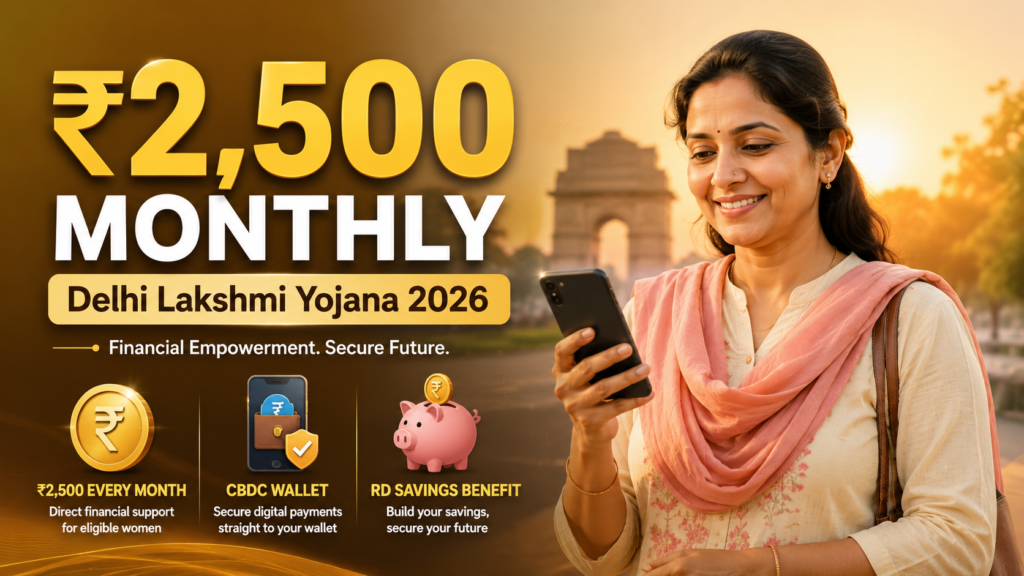
The scheme is aimed at economically weaker women between the ages of 21 and 60 years who satisfy the government’s residency, income, family and other eligibility requirements. The Delhi Government has earmarked roughly ₹5,110 crore for the scheme in the 2026 27 Budget, and it is expected to eventually benefit close to 17 lakh women across the National Capital Territory of Delhi over a three year period.
The online registration portal, dly.delhi.gov.in, was launched by Delhi Chief Minister Rekha Gupta on August 1, 2026, and the scheme has attracted enormous public attention — with reports of well over a lakh registrations within the first two days alone. The important point for applicants, however, is that simply submitting an application does not automatically guarantee payment. Every application must pass a prescribed verification and approval process before a beneficiary starts receiving money.
The scheme also combines financial assistance with a structured payment mechanism, digital finance and compulsory or optional savings — making it more layered than a simple cash transfer programme. This guide explains what the scheme is, who can apply, what documents are required, how the money is actually paid out, and what applicants should watch out for, including a growing number of scam messages circulating in the name of the scheme.
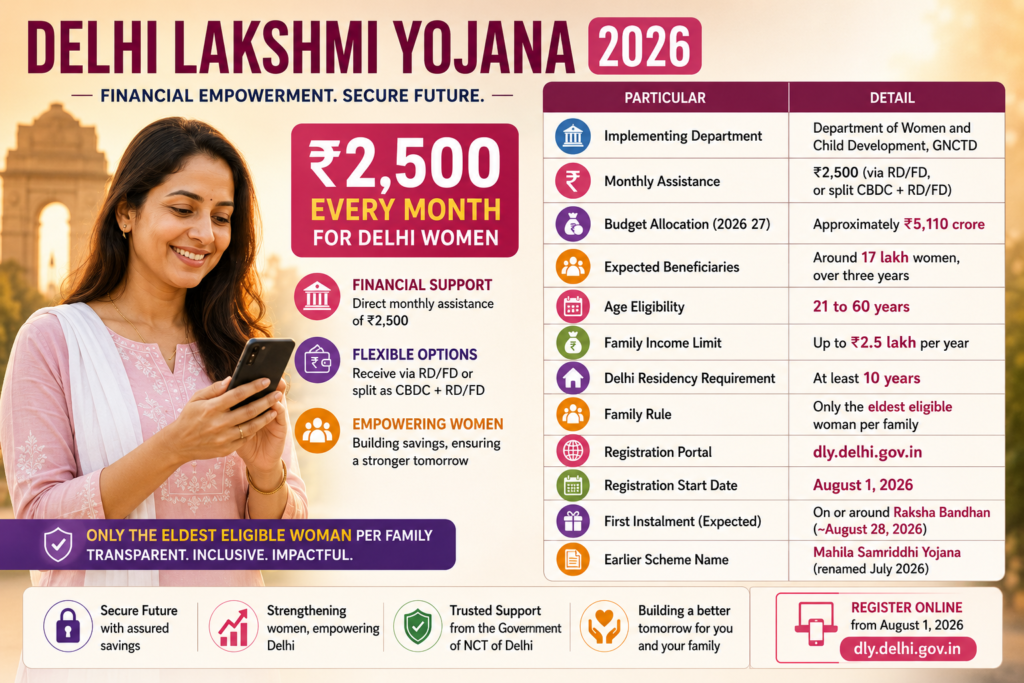
Delhi Lakshmi Yojana 2026 Key Facts at a Glance
| Particular | Detail |
| Implementing Department | Department of Women and Child Development, GNCTD |
| Monthly Assistance | ₹2,500 (via RD/FD, or split CBDC + RD/FD) |
| Budget Allocation (2026 27) | Approximately ₹5,110 crore |
| Expected Beneficiaries | Around 17 lakh women, over three years |
| Age Eligibility | 21 to 60 years |
| Family Income Limit | Up to ₹2.5 lakh per year |
| Delhi Residency Requirement | At least 10 years |
| Family Rule | Only the eldest eligible woman per family |
| Registration Portal | dly.delhi.gov.in |
| Registration Start Date | August 1, 2026 |
| First Instalment (Expected) | On or around Raksha Bandhan (~August 28, 2026) |
| Earlier Scheme Name | Mahila Samriddhi Yojana (renamed July 2026) |
This table is only a starting reference every condition listed here is explained in full detail in the sections that follow, since eligibility ultimately depends on the complete picture rather than any single factor in isolation.
Table of Contents
What Is Delhi Lakshmi Yojana?
Delhi Lakshmi Yojana (DLY) is a Direct Benefit Transfer (DBT) based social welfare scheme run by the Department of Women and Child Development (WCD), Government of NCT of Delhi, designed to provide monthly financial assistance to eligible women.
The scheme takes a targeted approach rather than offering the benefit to every woman in the capital. Applicants must satisfy several conditions relating to:
- Age
- Family income
- Delhi residency (including a 10 year residency condition)
- Family structure (only the eldest eligible woman in a family qualifies)
- Number of children
- Employment status (government/PSU employees are excluded)
- Tax and GST status
- Vehicle ownership and household electricity consumption
- Successful document verification
Unlike an unrestricted cash transfer programme, the scheme also gives beneficiaries a choice in how the money is delivered. Applicants can choose to receive the entire ₹2,500 in a Recurring Deposit (RD) or Fixed Deposit (FD) account, or split it so that ₹1,000 goes into a Central Bank Digital Currency (CBDC) wallet for everyday spending while ₹1,500 goes into an RD/FD with a three year lock in. This structure is designed to provide some immediate purchasing support while also encouraging long term savings.
From Mahila Samriddhi Yojana to Delhi Lakshmi Yojana
Many applicants are confused about the scheme’s name because it has changed. The benefit was first promised in the BJP’s manifesto for the 2025 Delhi Assembly elections and was approved by the Delhi Cabinet on March 8, 2025 (International Women’s Day) under the name Mahila Samriddhi Yojana. Chief Minister Rekha Gupta announced the Cabinet approval herself, along with the ₹5,110 crore budgetary provision, and a committee headed by the Chief Minister — including ministers Ashish Sood, Parvesh Sahib Singh and Kapil Mishra — was formed to oversee implementation.
In July 2026, the scheme was officially renamed Delhi Lakshmi Yojana, and it is under this name that the registration portal went live on August 1, 2026. There is no separate Mahila Samriddhi Yojana portal — anyone who was tracking the scheme under its earlier name should apply only through the official Delhi Lakshmi Yojana portal at dly.delhi.gov.in.
Applicants should be cautious of any third party website, app or agent claiming to run a separate “Mahila Samriddhi Yojana” registration process, since the scheme now operates exclusively under its new name and through the official government portal.
Why Has the Delhi Government Introduced the Scheme?
Financial insecurity can affect women’s access to healthcare, education, nutrition, household necessities and opportunities for economic participation. A predictable monthly assistance programme can meaningfully ease this burden for qualifying households.
Chief Minister Rekha Gupta has described the scheme as going beyond a simple cash transfer, aiming instead to connect beneficiaries with digital finance, savings instruments and broader social welfare programmes. The broader objectives of Delhi Lakshmi Yojana include:
- Supporting economically weaker women
- Improving household financial security
- Encouraging structured, disciplined savings
- Supporting essential household expenditure
- Promoting women’s economic participation and financial inclusion
- Creating a long term financial cushion through RD/FD accounts
- Targeting welfare assistance toward genuinely eligible families through strict verification
The scheme therefore goes beyond simply transferring money. Its structure combines monthly assistance, optional digital spending through a CBDC wallet, and a compulsory or chosen savings component.
There is also a wider policy backdrop to this design choice. Many cash transfer schemes in India have historically faced criticism for either being spent immediately without building any lasting financial resilience, or for being difficult to monitor once disbursed. By channelling a guaranteed portion of the assistance into an RD/FD account, the Delhi Government appears to be trying to address both concerns at once ensuring beneficiaries have some funds for near term needs while also building a locked, interest bearing corpus that cannot be casually spent away. The CBDC component adds a further layer, since a digital wallet with a built in “negative list” allows the government to encourage spending on genuine household necessities while restricting a narrow set of categories such as alcohol and tobacco. Whether this layered structure works as intended in practice will depend heavily on how smoothly the CBDC and banking infrastructure functions for a beneficiary base that may not be uniformly comfortable with digital wallets — which is itself a reason applicants should carefully weigh the CBDC option against the simpler full RD/FD route described in Section 5.
5. Delhi Lakshmi Yojana Benefit Amount
The headline benefit under the scheme is ₹2,500 per month, which works out to ₹30,000 in a year if a beneficiary receives the assistance for all twelve months.
However, applicants should understand that the entire ₹2,500 is not automatically handed out as unrestricted cash every month. At the time of applying, every applicant must choose one of two payment options on the portal:
- Option A: The full ₹2,500 per month is deposited into a Recurring Deposit (RD) or Fixed Deposit (FD) account, which carries a three year lock in period and, according to the government, a sovereign guarantee from the Delhi Government.
- Option B: ₹1,000 per month is credited to a CBDC wallet for day to day household spending, while the remaining ₹1,500 per month goes into an RD/FD account with the same three year lock in.
Applicants who choose the CBDC wallet option must have a smartphone capable of operating the wallet, and their bank account must be with a lender that participates in the Reserve Bank of India’s CBDC ecosystem. Beneficiaries should therefore choose the payment option that best fits their needs before submitting the application, since this choice affects how much cash equivalent support is actually available to them each month versus how much is locked away as savings.
6. Who Can Apply for Delhi Lakshmi Yojana?
The basic target group consists of women who satisfy the prescribed economic, residential and family conditions.
The principal eligibility requirements include:
- The applicant must be a woman.
- She must be between 21 and 60 years of age as on the date of application.
- She must be a permanent resident of Delhi and satisfy the 10 year residency requirement.
- She must be the eldest eligible woman in her family.
- The family’s annual income must not exceed ₹2.5 lakh.
- The applicant must hold a valid Aadhaar card and a Delhi Voter ID card.
- The applicant must not fall within any of the specified exclusion categories (see Section 12).
- The application must successfully pass departmental verification.
Meeting one condition alone is not enough — eligibility is determined by considering the complete set of requirements together.
7. Age Requirement
The scheme is targeted at women aged between 21 and 60 years, calculated as on the date the application is submitted.
This means applicants below 21 or above 60 fall outside the eligible beneficiary group. Applicants should ensure the date of birth entered in the application matches their official documents exactly, since a mismatch can cause problems at the verification stage.
Acceptable age proof documents include a birth certificate, school leaving certificate, Class 10 marksheet/certificate, or driving licence. It is advisable to keep one of these documents ready in scanned form before starting the online application.
8. Family Income Limit
Economic eligibility is a central requirement of the scheme. The family’s annual income must not exceed ₹2.5 lakh.
Applicants should understand that this is assessed as a family level income limit, not merely the applicant’s individual salary or personal earnings. Supporting documents such as a BPL card, yellow ration card, EWS certificate, or an income certificate proving the family’s low annual income may be required, particularly during scrutiny.
Providing incomplete or inaccurate income information can result in rejection at the verification stage, or in cancellation of benefits later if a discrepancy is discovered.
9. Delhi Residency Requirement
One of the most emphasised conditions in the scheme is the 10 year Delhi residency requirement. The applicant must have been a resident of Delhi for at least ten years and must submit a self declaration confirming continuous residence at the time of registration.
This residency can be demonstrated through documents such as an old Delhi Voter ID card, ration card, driving licence, or electricity/gas connection bills going back far enough to establish a decade of residence. Applicants should therefore gather older residential documents in advance, since a single recent utility bill will not, by itself, establish ten years of residency.
Note that even applicants who previously qualified under the erstwhile Mahila Samriddhi/Delhi Mahila Samman scheme criteria must separately ensure they can produce the 10 year residency proof now required under Delhi Lakshmi Yojana.
10. One Woman Per Family Rule (The “Eldest Eligible Woman” Rule)
A defining feature of Delhi Lakshmi Yojana is that only one woman per family can receive the benefit — specifically, the eldest eligible woman in that family, as confirmed on the scheme’s official portal.
This prevents multiple claims from the same household. The rule becomes particularly important in extended or joint families where several adult women may live under one roof — for example, a household with a mother, a daughter in law and an adult daughter. In such cases, only the eldest among the eligible women can receive the ₹2,500 assistance, even if more than one of them individually meets the age, income and residency conditions.
The existence of separate names on ration cards or utility bills does not automatically create separate “families” for the purposes of this rule — which is why the government’s underlying definition of a family matters considerably (see the next section).
11. How the Government Defines a Family
For welfare schemes of this kind, “family” is typically understood through the household or ration card unit rather than through individual documents alone. In practice, this means that having a separate electricity meter or a separate gas connection in one woman’s name does not, by itself, prove that she heads a separate family for scheme purposes if she continues to live within the same household unit as other family members.
This has practical significance for joint families. Applicants should provide truthful, consistent information about their household structure rather than attempting to file multiple applications by relying only on separate utility connections or documents. Since only the eldest eligible woman per family can be approved, the department’s verification process is designed to catch inconsistent or duplicate claims arising from the same household.
Applicants who are uncertain how their specific household will be classified — for instance, in cases of separated but not legally divided joint families — may wish to seek guidance before applying rather than risk a rejection or a later verification dispute.
12. Who Is Not Eligible?
The scheme contains several clearly stated exclusion criteria. Based on the eligibility guidelines released by the Delhi Government, the following categories are excluded from receiving the benefit, even if they otherwise meet the age, income and residency conditions:
- Women who are Central Government, Delhi Government, or Public Sector Undertaking (PSU) employees, or whose family includes such an employee
- Income tax payers
- GST registered individuals/GST filers
- Families owning a four wheeler
- Families whose annual electricity consumption exceeds 2,400 units
- Women with more than three living children
- Women already receiving financial assistance under certain other conflicting government welfare schemes
Applicants who fall into any of these categories, or whose family does, will not be approved even if they successfully complete online registration. This shows that Delhi Lakshmi Yojana is a targeted welfare programme rather than a universal payment to every woman in Delhi.
It is worth noting that these exclusions are cumulative rather than independent — a family could clear the income test comfortably and still be excluded on an entirely separate ground, such as electricity consumption or a family member’s GST registration. Applicants who are uncertain whether a specific circumstance in their household (a family member with a small business that is GST registered, for instance, or a car that is jointly owned but rarely used) would trigger an exclusion should treat this as a genuine grey area worth clarifying before applying, rather than assuming the most favourable interpretation on their own.
13. Three Child Eligibility Restriction
One of the most publicly discussed provisions of the scheme is the family size condition: women with more than three living children are not eligible, regardless of whether they meet every other criterion.
This condition has also become politically contentious. Following the government’s clarification of this rule, opposition leader Arvind Kejriwal publicly questioned the condition, contrasting it with unrelated remarks made by RSS chief Mohan Bhagwat about family size, and the exchange sparked a wider political debate about whether the rule was appropriate. Readers should treat this as an ongoing public and political discussion rather than a settled matter — different political parties and commentators hold different views on the rule, and the government has stood by the eligibility condition as notified.
For applicants, the practical takeaway is straightforward: the number of living children must be accurately declared. Since welfare applications are subject to verification, submitting false information about family size to qualify can create serious legal and administrative consequences later.
14. Government Employees, Taxpayers and GST Filers
The scheme is designed for economically weaker and non salaried households, and it therefore excludes categories generally considered to be in more financially secure or formal sector positions.
Women who are themselves government employees, or whose family includes an employee of the Central Government, the Delhi Government, or a Public Sector Undertaking, are not eligible. Similarly, income tax payers and GST filers fall within the stated exclusion categories.
Applicants should not assume that a currently low personal income overrides these exclusion conditions — the criteria must be read together, and a family that includes even one member who is a government employee, an income tax payer, or a GST filer may be disqualified regardless of the applicant’s own income level.
15. Four Wheeler and Electricity Consumption Restrictions
Beyond income and employment, the scheme also uses asset based indicators to identify genuinely economically weaker households.
Two conditions apply here:
- Four wheeler ownership: Families that own a four wheeler are excluded from the scheme.
- Electricity consumption: Families whose annual electricity consumption exceeds 2,400 units are excluded, since high consumption is treated as an indicator of a household that may not fall within the intended economically weaker beneficiary group.
Applicants should disclose vehicle ownership and be prepared for electricity records to be checked during verification. Attempting to conceal an asset or understate electricity usage can create serious problems if the application is cross checked against government or utility records during scrutiny.
16. Do Ration Card or Ayushman Bharat Beneficiaries Get Excluded?
A common point of confusion is whether receiving benefits under other welfare programmes automatically disqualifies a woman from Delhi Lakshmi Yojana.
The exclusion criteria refer specifically to women “already receiving financial assistance under certain other government welfare schemes” that may conflict with this one. According to public clarifications on the scheme, being a beneficiary of the Public Distribution System (ration card) or Ayushman Bharat health coverage does not, by itself, disqualify a woman from Delhi Lakshmi Yojana — these are treated as separate welfare safety nets rather than competing cash assistance schemes.
That said, since the exact list of “conflicting” schemes can be updated or clarified by the department from time to time, applicants who are currently receiving benefits under any other cash assistance or pension scheme should verify their specific eligibility on the official portal, or through the Women & Child Development Department, before assuming automatic eligibility.
17. How the ₹2,500 Benefit Will Be Distributed
The payment mechanism is one of the most distinctive aspects of Delhi Lakshmi Yojana. Unlike a conventional scheme where the entire amount is transferred directly into an unrestricted bank account, applicants must actively choose between two payment structures while filling out the application:
Option A — Full RD/FD Route
The entire ₹2,500 per month is deposited into a Recurring Deposit or Fixed Deposit account, locked in for three years.
Option B — Split CBDC + RD/FD Route
₹1,000 per month is credited to a CBDC wallet for immediate household spending, while the remaining ₹1,500 per month goes into an RD/FD account, also locked in for three years.
This “choose your own structure” design is meant to let beneficiaries decide how much of the assistance they need as usable funds right away versus how much they would prefer to grow as locked savings. Once selected during registration, the option chosen governs how the beneficiary’s monthly ₹2,500 is actually disbursed.
18. What Is a CBDC Wallet?
CBDC stands for Central Bank Digital Currency — a digital form of the Reserve Bank of India’s sovereign currency (the digital Rupee, or e₹), distinct from ordinary bank deposits or private digital wallets.
Under Delhi Lakshmi Yojana, beneficiaries who choose the CBDC option receive ₹1,000 per month directly into a CBDC wallet linked to a participating bank account. To use this option, the applicant needs:
- A smartphone capable of running the CBDC wallet app
- An Aadhaar linked bank account with a lender that participates in the RBI’s CBDC ecosystem
The CBDC component is intended to function as controlled digital purchasing power for household needs rather than as ordinary, unrestricted cash. This is an important distinction for applicants to understand before choosing this option over the full RD/FD route.
19. Restrictions on CBDC Spending
The scheme places restrictions on how the CBDC wallet component can be spent. The government has indicated that a digital “negative list” blocks the wallet from being used to purchase certain prohibited categories, which typically include items such as alcohol and tobacco products, and similarly restricted goods or services.
The policy objective behind this restriction is to ensure that welfare money is directed toward genuine household and essential expenditure rather than discretionary or harmful spending. Beneficiaries who choose the CBDC option should therefore understand that they will not have unrestricted control over every possible spending category through that wallet — this is a deliberate design feature of the scheme, not a technical glitch.
20. The RD/FD Savings Component
Whichever payment option a beneficiary chooses, at least ₹1,500 of the monthly ₹2,500 (or the full amount, under Option A) goes into a Recurring Deposit or Fixed Deposit account carrying a three year lock in period. The government has described this FD component as carrying a sovereign guarantee from the Delhi Government.
This built in savings mechanism is intended to help beneficiaries accumulate a meaningful financial cushion over the scheme’s three year run, subject to the applicable interest rate and the actual monthly deposit schedule. A savings corpus of this kind could potentially support future needs such as:
- Children’s education expenses
- Healthcare costs
- Household emergencies
- Skill development opportunities
- General long term financial security
The precise maturity value will depend on the interest rate applied by the bank/post office account and how consistently the monthly deposits are made and maintained without default.
20A. Thinking Through the RD/FD Lock In Before You Choose
Because the RD/FD component of Delhi Lakshmi Yojana is locked in for three years, it is worth pausing on this choice rather than treating it as a minor form filling detail.
If a household needs more monthly liquidity right now for recurring expenses like rent, school fees, or medical needs the split option (₹1,000 via CBDC wallet plus ₹1,500 into RD/FD) may feel more practical, since it provides some usable funds every month rather than locking away the entire amount.
If a household can manage its current monthly expenses without this assistance and would prefer to build a guaranteed, interest bearing corpus for a future goal — such as a child’s education, a wedding, or an emergency fund — the full RD/FD route may be more useful, since the entire ₹2,500 compounds together rather than being split across two instruments.
Either way, applicants should treat the RD/FD portion as genuinely locked for three years and should not plan household budgets assuming early access to it. Since this is a state government linked deposit rather than an ordinary personal RD/FD, applicants should also clarify directly with their bank or the scheme portal what happens in the rare event of premature closure being required for a genuine emergency, rather than assuming standard bank RD/FD withdrawal rules will automatically apply.
This is a financial planning decision specific to each household’s circumstances, and applicants who are unsure which option suits them may wish to discuss it with a trusted family member or, where the amounts involved are significant to their household budget, a financial adviser — this article outlines the mechanics of each option but is not a substitute for advice tailored to an individual family’s finances.
21. How Long Is the Scheme Expected to Run?
Delhi Lakshmi Yojana is designed as a three year initiative, closely tied to the three year lock in period on the RD/FD component. Government statements have described the scheme as intended to help around 17 lakh women “over three years.”
This should not be read as meaning the scheme will automatically be discontinued the day the three year period ends like most Indian welfare schemes, Delhi Lakshmi Yojana could be reviewed, extended, modified, or restructured by the government based on future budgetary provisions and policy decisions. However, applicants should currently plan around the three year framework that has been publicly announced, particularly with respect to when their RD/FD deposits will mature and become accessible.
22. Delhi Lakshmi Yojana Online Registration
The application process is entirely digital and must be completed through the official portal only: dly.delhi.gov.in. There is no offline or paper based application route, and no separate portal exists under the scheme’s earlier name.
A typical online application involves the following broad steps:
- Visiting the official portal, dly.delhi.gov.in.
- Registering with an active mobile number and verifying it via OTP.
- Creating or logging into the applicant profile.
- Entering personal details (name, date of birth, Aadhaar number).
- Providing family details, including information relevant to the “eldest eligible woman” rule.
- Entering residency information and the 10 year self declaration.
- Providing income related information.
- Choosing a payment option — full RD/FD, or the split CBDC + RD/FD route.
- Uploading the required documents in clear, legible formats.
- Completing the declaration and submitting the application.
- Saving the acknowledgement or application reference number for future tracking.
Applicants should review every field carefully before final submission. Current reporting on the scheme’s early rollout has flagged concerns about limited ability to edit information after submission, so it is far better to get every detail right the first time than to try correcting it afterward.
Given the overwhelming initial response — reportedly well over a lakh applications within the first two days of the portal going live — applicants should expect some server load and should be patient, while still avoiding any temptation to use third party “assistance” websites that are not part of the official government portal.
23. Documents Required
Applicants should keep the following documents ready, in clear scanned copies, before beginning registration.
Mandatory Documents
- Aadhaar Card
- Delhi Voter ID Card
- Recent passport size photograph and signature
- Recommendation/endorsement letter from the MP or MLA of the applicant’s constituency
Residential Proof for 10 Years (any one)
- Delhi Voter ID Card (old)
- Ration Card
- Driving Licence
- Electricity meter bill or gas connection bill/receipt
Age Proof (any one)
- Birth Certificate
- School Leaving Certificate (last class attended)
- Class 10 Marksheet/Certificate
- Driving Licence
Other Supporting Documents
- Bank passbook of an Aadhaar linked savings account (with a bank participating in the CBDC ecosystem, if choosing the wallet option)
- BPL/EWS ration card or income certificate, wherever applicable, to support the family income declaration
Note that the requirement of an MP/MLA recommendation letter is one of the more distinctive document requirements for this scheme and is worth arranging early, since it may take longer to obtain than personal identity documents. The competent authority may also request additional documents during scrutiny if needed, so applicants should be prepared to respond promptly to any such request.
Why Each Category of Document Matters
It helps to understand why the department asks for each document, rather than treating the checklist as an arbitrary formality:
- Identity documents (Aadhaar, Voter ID) establish that the applicant is who she claims to be and prevent duplicate registrations under different names.
- Residency documents spanning 10 years exist specifically because the scheme is meant for long term Delhi residents, not recent arrivals — a single current dated document cannot prove a decade of residence, which is why the list favours older records like an old voter ID, ration card, or utility connection.
- Age proof confirms the applicant genuinely falls within the 21–60 window, since the scheme is not open to minors or to women above the upper age limit.
- The MP/MLA recommendation letter functions as a local level endorsement that the applicant genuinely resides in, and is known within, the constituency she claims — it is not a political favour but a formal part of the verification chain.
- Bank passbook details ensure the DBT and, where applicable, the CBDC wallet are correctly linked to an account the applicant genuinely controls.
Understanding this rationale can help applicants gather the right version of each document (for instance, an old rather than recently issued residency document) rather than simply the most convenient one on hand.
24. Beware of Fake Links, WhatsApp Messages and Scams
Because Delhi Lakshmi Yojana involves a direct cash benefit to millions of women, it has already become a target for fraud. Reports have flagged WhatsApp and SMS messages of the kind: “Delhi Lakshmi Yojana ₹2,500 Approved — click here to receive your money.” Clicking such links can lead to fake websites designed to steal banking credentials, or prompt the download of a malicious APK file that can empty a victim’s bank account once installed.
Applicants should keep the following in mind:
- The Delhi Government will never ask for your UPI PIN, ATM card number, or CVV through a text message or link.
- Approval and payment updates should be checked only by logging into the official portal, dly.delhi.gov.in — never through a link received via SMS, WhatsApp, or email.
- Do not install any APK file sent by an unknown sender claiming to be related to this scheme.
- If you receive a suspicious message, do not click the link or respond. Report it to the National Cyber Crime Reporting Portal or call the cyber crime helpline at 1930.
- Be equally cautious of unofficial “agents” or middlemen who offer to get an application “approved faster” for a fee — there is no legitimate paid fast track process for this scheme.
Given how many women are expected to apply, exercising this basic caution is one of the single most important protective steps an applicant can take.
25. Application Verification Process
Registration is only the first stage. Every application is expected to undergo departmental scrutiny before approval, which may examine:
- Applicant identity and age, matched against submitted documents
- Delhi residency and the 10 year continuous residence claim
- Family composition, to confirm the applicant is genuinely the eldest eligible woman
- Family income
- Employment status (to rule out government/PSU employment)
- Tax and GST status
- Vehicle ownership and electricity consumption records
- Number of living children
- Any conflicting benefits under other welfare schemes
This multi point verification is intended to reduce duplicate, fraudulent, or genuinely ineligible claims from being approved, given the scale of public money involved (₹5,110 crore budgeted, spread across an expected 17 lakh beneficiaries).
What to Expect on Timing
The Delhi Government has not published a fixed, guaranteed turnaround time for verification, and given the very high initial volume of applications — reportedly well over a lakh within the first two days of the portal’s launch processing times are likely to vary. Applicants should treat the government’s stated target of releasing the first instalment around Raksha Bandhan as an intended goal for those who register and get verified early, rather than an absolute guarantee for every applicant regardless of when they apply. Applying as early and as accurately as possible remains the best way to maximise the chance of being included in an early disbursement cycle.
25A. Public Response and Political Debate Around the Scheme
Delhi Lakshmi Yojana has generated an unusually strong public response since its launch, with reports of hundreds of thousands of women registering within the very first days of the portal going live. This level of interest reflects the scale of demand for direct financial support among Delhi’s women, and it is also part of why the government has emphasised a structured verification process — to manage a very large applicant pool fairly and to keep the scheme targeted at those it is meant to serve.
At the same time, specific provisions of the scheme have drawn political debate. The most prominent example is the three child eligibility restriction (Section 13), which opposition leaders have publicly questioned, including a widely reported exchange in which AAP’s Arvind Kejriwal contrasted the rule with separate remarks on family size made by RSS chief Mohan Bhagwat. The Delhi Government has maintained the eligibility condition as notified. Similarly, some commentary has focused on whether the CBDC and RD/FD payment structure — as opposed to a simpler direct cash transfer — genuinely serves beneficiaries’ immediate needs as well as a fully liquid payment would.
These are legitimate points of public debate, and different stakeholders reasonably hold different views on them. For an individual applicant, however, the practical reality is that the scheme’s rules, as currently notified, govern whether and how she can access the benefit — so understanding the rules as they stand today (rather than as they might be debated or potentially revised in the future) is the most useful starting point for deciding whether and how to apply.
26. Role of the Women & Child Development Department
The Department of Women and Child Development (WCD), Government of NCT of Delhi is the nodal department implementing Delhi Lakshmi Yojana, and district administrative machinery supports the department in scrutiny and rollout at the ground level.
Applicants who need help or clarification regarding their application are advised to contact the District Women and Child Development Department office relevant to their area, in addition to using the helpline and support channels listed on the official portal. Given that this is a newly launched, high volume scheme, applicants should expect some administrative learning curve in the early months and should follow official communications for the most current guidance on processing timelines.
27. Grievance Redressal Mechanism
Any large welfare programme needs a formal system for handling complaints, and applicants may need to raise a grievance where:
- An application is wrongly rejected.
- Information has been incorrectly recorded.
- Verification remains pending for an unusually long time.
- A payment is not received despite approval.
- A submitted document is rejected without adequate explanation.
- An applicant is incorrectly treated as belonging to the same family as another claimant.
- There is a factual error in residency, income, or family verification.
Applicants should preserve their application/reference number, uploaded documents, and any communication received from the department, since these will be needed to support a grievance. Where the official grievance channel does not resolve an issue satisfactorily, applicants may consider seeking professional guidance on the appropriate next steps (see Section 31).
Practical Steps for Filing a Grievance
- Gather your records first — application number, all uploaded documents, screenshots of status updates, and any rejection or query message received.
- Identify the specific ground for your grievance (wrong rejection, pending verification beyond a reasonable time, incorrect family linkage, missing payment despite approval, and so on) so your complaint is precise rather than general.
- Use the official grievance channel listed on the dly.delhi.gov.in portal, or approach the District Women and Child Development Department office for your area in person if an online channel is unavailable or unresponsive.
- Keep a written or reference numbered record of your grievance submission itself, not just your original application.
- Follow up within a reasonable interval rather than assuming silence means rejection — but also avoid submitting duplicate grievances for the same issue, since this can create confusion in the department’s records.
- Escalate or seek professional help if the grievance remains unresolved for an unreasonably long period, or if you believe the decision involves a factual or legal error rather than a simple processing delay.
A calm, well documented grievance is far more likely to be resolved quickly than a vague or repeated complaint, so it is worth investing a little time in preparing it properly.
27A. How to Track Your Application Status After Registration
Once an application has been submitted, the applicant should periodically check its status rather than assuming it is progressing automatically in the background. While the exact tracking interface can change as the portal matures, applicants can generally expect to do the following:
- Log in with the same mobile number and OTP used at the time of registration, rather than trying to create a new profile.
- Use the saved application/reference number as the primary way to look up status, since this number is the department’s internal identifier for the case.
- Check for status labels such as “Submitted,” “Under Verification,” “Additional Documents Required,” “Approved,” or “Rejected,” and read any accompanying remarks carefully — particularly if additional documents have been requested, since failing to respond within the specified window could affect the outcome.
- Avoid re submitting a fresh application just because the status has not changed quickly, since duplicate applications from the same person can complicate rather than speed up processing.
- Keep a personal record (a screenshot or printed copy) of each status update, in case it is needed later for a grievance.
If the status remains unchanged for an unusually long period without any explanation, the applicant should raise the matter through the official grievance channel described in Section 27, rather than repeatedly re submitting information or relying on unofficial sources for updates.
28. What Happens After Application?
After submission, applicants should not assume immediate or automatic approval. The general process can be understood as:
Online Application → Document Upload → Departmental Scrutiny/Verification → Approval → Payment Option Activation (RD/FD and/or CBDC Wallet) → Monthly DBT Disbursement
Only an applicant who clears every stage of this process, and who genuinely satisfies all eligibility conditions, should expect to start receiving the monthly benefit. The Delhi Government has indicated that the first instalment is targeted for release around Raksha Bandhan (expected on or around August 28, 2026) for applicants who complete registration and verification in time. Applicants should regularly check their application status on the official portal rather than relying on unofficial updates.
29. Common Mistakes Applicants Should Avoid
Mistake 1: Entering incorrect family information
The “eldest eligible woman” rule and the family based income assessment make accurate family details essential.
Mistake 2: Giving an incorrect income figure
Income information should be accurate and backed by supportable documents like a BPL card or income certificate.
Mistake 3: Hiding a four wheeler or understating electricity consumption
These are specific, checkable exclusion criteria; concealment discovered during verification can lead to rejection or cancellation.
Mistake 4: Incomplete or inconsistent residency proof
The 10 year residency condition needs proper supporting documents, not just a recent address.
Mistake 5: Submitting duplicate applications from the same household
Only the eldest eligible woman per family can be approved; multiple applications from one household can create verification delays for everyone involved.
Mistake 6: Uploading unclear or mismatched documents
Blurry uploads or documents with details that don’t match the application form can delay verification significantly.
Mistake 7: Relying on unofficial websites, agents, or “fast track” offers
Applicants should use only the official portal, dly.delhi.gov.in, and should be alert to the scam patterns described in Section 24.
Mistake 8: Assuming registration itself means approval
Registration is only the first step; approval depends on successful verification against all eligibility conditions.
Mistake 9: Delaying document collection, especially the MP/MLA letter
Since the recommendation letter can take time to arrange, applicants should start collecting it early rather than at the last stage of filling the form.
Mistake 10: Choosing a payment option without thinking it through
Because the RD/FD component is locked for three years, applicants should weigh the full RD/FD route against the split CBDC plus RD/FD route carefully (see Section 20A) rather than picking an option at random or copying a neighbour’s choice without considering their own household’s needs.
Mistake 11: Ignoring status updates or document requests
If the department requests additional documents or clarification during verification, failing to respond promptly can result in an otherwise eligible application being closed or delayed indefinitely.
30. Legal Importance of Correct Information
A government welfare application should be treated as a formal declaration, not a casual form. Providing false or misleading information — about income, family structure, number of children, vehicle ownership, or residency — can result in:
- Rejection of the application
- Cancellation of an already sanctioned benefit
- Recovery of any wrongly received amounts
- Administrative action against the applicant
- Potential legal consequences in serious cases of deliberate misrepresentation
Applicants should never manufacture documents, conceal assets, or misstate family details merely to qualify for the benefit. If there is genuine uncertainty about how a particular circumstance (for example, a recently separated joint family, or a family member’s employment status) affects eligibility, it is far better to seek clarification before submitting the application than to guess and risk later cancellation or recovery proceedings.
31. How Legalaidindia.org Can Assist
Applicants who face legal, procedural, or documentation difficulties in connection with Delhi Lakshmi Yojana may seek professional assistance from Legalaidindia.org. Potential areas of assistance include:
Eligibility Guidance
Helping applicants understand how family income, household structure, the “eldest eligible woman” rule, residency proof, and the various exclusion criteria may apply to their specific situation.
Document Review
Reviewing identity, residency, age, and income documents for completeness and internal consistency before they are uploaded to the portal, to reduce the risk of a verification delay or rejection.
Application Assistance
Guiding applicants who are unfamiliar with online government portals through the information genuinely required at each stage of the Delhi Lakshmi Yojana registration process.
Scam and Fraud Awareness Support
Helping applicants distinguish official communications from the fraudulent WhatsApp/SMS messages and fake links described in Section 24, and advising on reporting suspicious contact to the cyber crime helpline.
Grievance Support
Where an eligible applicant believes her application has been incorrectly rejected, delayed, or wrongly linked to another family member’s claim, helping her understand and pursue the appropriate grievance channel with the Women & Child Development Department.
Representation and Legal Notices
Where a dispute requires formal communication with an authority, or where a legal notice or representation may be appropriate, providing suitable professional support.
It is important to be clear eyed about the limits of this kind of assistance: no private service provider can guarantee the approval of a government welfare application. Final eligibility determination and approval remain entirely with the competent government authorities under the Delhi Lakshmi Yojana rules. What professional legal guidance can do is help ensure an application is accurate, complete, and properly supported — and help navigate the correct remedy if something genuinely goes wrong.
32. Delhi Lakshmi Yojana Compared With Similar Schemes in Other States
Delhi Lakshmi Yojana is part of a broader trend of state governments across India launching monthly cash assistance schemes for women, though the specific design of each scheme differs quite a bit. Understanding these differences can help applicants (and readers comparing coverage across states) see what makes the Delhi scheme distinctive.
Maharashtra’s Mukhyamantri Majhi Ladki Bahin Yojana provides ₹1,500 per month to married, divorced, and destitute women aged 21–65, with an annual family income cap of ₹2.5 lakh, paid as straightforward Direct Benefit Transfer without a mandatory savings or digital wallet component.
Haryana’s Deendayal Lado Lakshmi Yojana provides ₹2,100 per month to women aged 23 and above (in its first phase, capped at families earning below ₹1 lakh annually), with no limit on how many eligible women from one family can receive the benefit — a notable contrast to Delhi’s strict “eldest eligible woman” rule.
Delhi Lakshmi Yojana, by comparison, offers the highest headline amount among these three at ₹2,500 per month, but is also the most structurally complex: it restricts the benefit to one woman per family, layers in a mandatory or optional savings component through an RD/FD account with a three year lock in, and gives applicants the added choice of a CBDC digital wallet for part of the assistance. It also carries a more extensive list of exclusion criteria — covering electricity consumption, vehicle ownership, GST status and family size — than either of the comparable state schemes.
For applicants, the practical implication is that Delhi Lakshmi Yojana cannot simply be understood by its headline ₹2,500 figure; its eligibility net and its payment structure are both narrower and more layered than similar sounding schemes in neighbouring states.
33. Related Delhi Government Women’s Welfare Initiatives
Delhi Lakshmi Yojana has not been launched in isolation. It follows the Delhi Government’s earlier Pink Saheli Smart Card Yojana, another women focused welfare initiative, and reflects a broader pattern of the current Delhi administration expanding its women’s welfare portfolio.
Applicants who are checking their eligibility for Delhi Lakshmi Yojana may find it useful to also review whether they are already covered under other Delhi Government women and family welfare schemes, since:
- Some benefits may be complementary rather than conflicting (as clarified for ration card and Ayushman Bharat coverage in Section 16).
- Understanding the full landscape of available schemes can help a family plan its finances more effectively, rather than relying on a single scheme.
- Future scheme announcements may build on the same digital infrastructure (Aadhaar linked accounts, DBT, and the CBDC ecosystem) used for Delhi Lakshmi Yojana.
Readers should always confirm the current status and rules of any related scheme directly through official Delhi Government sources, since welfare programmes are periodically reviewed, renamed, or restructured — as happened with Delhi Lakshmi Yojana itself when it moved from the Mahila Samriddhi Yojana name to its current one.
34. A Closer Look at the Online Registration Walkthrough
Building on the broad steps outlined in Section 22, applicants may find it helpful to understand what typically happens at each stage of the online journey in more detail.
Before you begin: Keep your Aadhaar card, Delhi Voter ID, one residency proof document going back at least ten years, one age proof document, a recent photograph, your Aadhaar linked bank passbook, and your MP/MLA recommendation letter scanned and saved on your device or computer. Having these ready before you open the portal will make the process considerably faster and reduce the chance of an incomplete or rushed submission.
Mobile verification: Registration begins with an active mobile number, which is verified through an OTP. This number should ideally be the same one linked to your Aadhaar, since it may be cross checked during verification.
Personal and family details: You will be asked to enter your name exactly as it appears on your Aadhaar card, your date of birth, and details establishing that you are the eldest eligible woman in your family. Small inconsistencies between what you type and what your documents show are a common cause of delay, so this section deserves careful attention.
Income and residency declarations: These sections typically involve both structured fields (such as a declared annual income figure) and a self declaration checkbox confirming the accuracy of your residency claim. Because these are legal declarations, they should never be filled in casually.
Choosing your payment option: This is the point at which you select either the full RD/FD route or the split CBDC plus RD/FD route. Take time to think through which option genuinely suits your household’s monthly needs versus its longer term savings goals, since this choice shapes how much usable money you will have each month for the next three years.
Document upload: Upload each document in the correct category, ensuring that scans are clear, complete, and not cropped. Blurry or partially visible documents are one of the most common reasons for delayed or rejected verification.
Final review and submission: Before clicking submit, re check every field against your original documents. Given that editing after submission may be limited, this final review step is arguably the single most important part of the entire process.
After submission: Note down your application/reference number immediately, and use only the official portal to track your status going forward.
34B. Illustrative Scenarios: Am I Eligible?
Because eligibility depends on several conditions applying together, it can help to see how the rules play out in a few hypothetical, illustrative situations. (These are generic examples for explanatory purposes only, not real individuals.)
Scenario 1 — Joint family, one working son. A 52 year old woman lives with her husband, her adult son, and her daughter in law. The son works a private sector job with no GST registration or government employment, and the family has no car. Total family income is ₹2.1 lakh a year, and the family has lived at the same Delhi address for over 15 years. She and her daughter in law (28) are both, in principle, within the 21–60 age band — but since only the eldest eligible woman per family can be approved, it is the 52 year old mother in law, not the daughter in law, who would be the eligible applicant here, assuming she otherwise clears every condition.
Scenario 2 — GST registered family business. A 35 year old woman meets every income, age and residency condition, but her husband runs a small shop that is GST registered. Because the exclusion criteria apply at the family level, this family would likely be excluded on GST grounds even though the applicant’s personal income and circumstances otherwise look eligible — illustrating why the “cumulative exclusions” point in Section 12 matters in practice.
Scenario 3 — Recently moved within Delhi. A 40 year old woman has lived in Delhi her whole life but changed addresses (and hence her registered voter address) four years ago after her marriage. Because the 10 year residency condition is about continuous Delhi residency rather than a single unchanged address, she would generally still be able to demonstrate 10 years of residency using a combination of older documents (for instance, her parental home’s electricity bill or an old voter ID) alongside her current address proof — but she should be prepared to submit more than one document to establish the full decade, rather than relying on her most recent address proof alone.
Scenario 4 — Four living children. A 45 year old woman meets the age, income and residency conditions comfortably, but has four living children. Despite otherwise qualifying, she would be excluded under the three child restriction described in Section 13.
These examples are meant to illustrate how the rules interact, not to predict the outcome of any specific real application — actual eligibility will always depend on an applicant’s exact documents and the department’s verification.
34C. Is the Delhi Lakshmi Yojana Benefit Taxable?
Applicants sometimes ask whether the ₹2,500 monthly assistance, or the interest earned on the RD/FD component, has any income tax implications. As a general matter, direct welfare assistance from a state government to economically weaker beneficiaries is not typically treated the same way as ordinary taxable income, and interest earned on small savings instruments is usually taxed only above certain thresholds under normal income tax rules.
That said, this article is not a substitute for professional tax advice, and the Delhi Government has not been the subject of any specific published tax ruling on this scheme at the time of writing. Beneficiaries — particularly those whose RD/FD component grows meaningfully over the three year lock in, or who have other taxable income — should raise this question with a qualified chartered accountant or tax adviser rather than assuming a particular tax treatment without checking, especially by the time the RD/FD matures after three years.
34D. Key Takeaways Before You Apply
- Delhi Lakshmi Yojana pays eligible women ₹2,500 per month, but only through an RD/FD account, or a split of a ₹1,000 CBDC wallet and ₹1,500 RD/FD, never as fully unrestricted cash by default.
- Only the eldest eligible woman in a family can receive the benefit — not every qualifying woman in a household.
- Eligibility requires age 21–60, family income up to ₹2.5 lakh, and 10 years of Delhi residency, along with clearing every exclusion criterion (government/PSU employment, income tax, GST, four wheeler ownership, electricity use above 2,400 units, and more than three living children).
- Applications go only through dly.delhi.gov.in; the scheme’s earlier name, Mahila Samriddhi Yojana, no longer has a separate portal.
- An MP/MLA recommendation letter is a required document and should be arranged early.
- Registration is not approval — every application is verified before any payment is released, with the first instalment targeted around Raksha Bandhan for those verified in time.
- Scam messages are already circulating in the scheme’s name; never click unsolicited links or share banking credentials, and verify status only through the official portal.
- When something goes wrong — a wrongful rejection, a stuck verification, or a documentation dispute — the official grievance channel is the first step, and professional guidance (including from services like Legalaidindia.org) can help where the issue is genuinely legal or procedural in nature.
Frequently Asked Questions
What is Delhi Lakshmi Yojana?
Delhi Lakshmi Yojana is a Delhi Government welfare scheme, run by the Department of Women and Child Development, that provides financial assistance of ₹2,500 per month to eligible women who satisfy prescribed conditions.
How much money will eligible women receive?
Eligible women receive ₹2,500 per month, totalling ₹30,000 in a year, delivered either fully into an RD/FD account or split between a CBDC wallet (₹1,000) and an RD/FD account (₹1,500), depending on the option chosen during application.
When did registration start?
Registration began on August 1, 2026, when the official portal dly.delhi.gov.in was launched by Chief Minister Rekha Gupta.
What is the age limit?
The stated age range is 21 to 60 years, calculated as on the date of application.
What is the annual family income limit?
The stated ceiling is ₹2.5 lakh per year for the applicant’s family.
Can more than one woman from a family apply?
No. Only the eldest eligible woman in a qualifying family can receive the benefit, even if other women in the same household also individually meet the age, income and residency conditions.
How is a family defined?
The scheme is applied at the household level; separate electricity or gas connections in different names do not automatically make members of the same household into separate “families” for scheme purposes.
Is Delhi residency mandatory?
Yes. Applicants must be permanent residents of Delhi and must have lived there for at least 10 years, supported by acceptable proof and a self declaration.
Can a government employee receive the scheme?
No. Women who are Central Government, Delhi Government, or PSU employees, or whose family includes such an employee, are excluded, No. Income tax payers & GST registered individuals
Can a woman with four children receive the benefit?
No. The scheme excludes women having more than three living children, a condition that has also generated public political debate.
Does high electricity usage disqualify a family?
Yes. Families whose annual electricity consumption exceeds 2,400 units are excluded
Does receiving a ration card or Ayushman Bharat benefit disqualify an applicant?
According to public clarifications on the scheme, being covered under the Public Distribution System (ration card) or Ayushman Bharat does not, by itself, disqualify an applicant these are treated as separate welfare programs rather than conflicting cash assistance schemes.
What is the CBDC wallet option?
It is one of two payment choices under the scheme, where ₹1,000 per month is credited to a Central Bank Digital Currency wallet for everyday spending, with the remaining ₹1,500 going into an RD/FD account.
When will the first instalment be paid?
The Delhi Government has indicated the first instalment is targeted for release around Raksha Bandhan, expected on or around August 28, 2026, for applicants who are verified in time.
Where should I apply?
Applications should be made only through the official portal, dly.delhi.gov.in, and never through unofficial agents, WhatsApp links, or third party websites.
How is Delhi Lakshmi Yojana different from Maharashtra’s Ladki Bahin Yojana or Haryana’s Lado Lakshmi Yojana?
Delhi’s scheme offers a higher monthly amount (₹2,500 versus ₹1,500 and ₹2,100 respectively), restricts the benefit to one eldest eligible woman per family, and adds a mandatory RD/FD savings component with an optional CBDC wallet features the other two state schemes do not use in the same way.
Is an MP or MLA recommendation letter compulsory?
Based on the documents notified for the scheme, an endorsement/recommendation letter from the applicant’s local MP or MLA is listed among the mandatory documents, so applicants should arrange this well in advance of applying.
Who should I contact for help with my application?
Applicants can approach the District Women and Child Development Department office for their area, use the support channels listed on the official portal (dly.delhi.gov.in), or seek independent professional guidance for documentation and grievance related questions.
Conclusion
The Delhi Lakshmi Yojana 2026 is a genuinely significant women focused welfare initiative, backed by a Cabinet approved budget of roughly ₹5,110 crore and expected to benefit close to 17 lakh women across Delhi. It offers a stated monthly benefit of ₹2,500 to eligible women who satisfy the government’s detailed conditions.
However, the headline figure should not be viewed in isolation. The scheme carries important requirements relating to age, family income, 10 year Delhi residency, the “eldest eligible woman” family rule, number of children, employment status, taxation, GST status, vehicle ownership and electricity consumption. It also uses a distinctive payment model: rather than handing over the entire amount as unrestricted cash, applicants choose between a full RD/FD route or a split route combining a CBDC wallet with an RD/FD savings account, creating both a modest immediate spending component and a genuine three year savings component.
For applicants, accuracy and caution are both essential. A carefully completed application, genuine supporting documents, and truthful disclosure of family and financial information will reduce the risk of verification problems — while staying alert to the fraudulent WhatsApp and SMS messages already circulating in the scheme’s name will protect against direct financial loss that has nothing to do with the scheme itself.The scheme is being implemented as a three year programme by the Department of Women and Child Development, with applications processed exclusively through the official online portal, dly.delhi.gov.in, and scrutinised through departmental verification before any payment is released.
Women who are uncertain about eligibility, documentation, family classification, rejection, payment problems, or grievance procedures may consider obtaining professional legal guidance. Legalaidindia.org can assist with understanding the applicable requirements and navigating the appropriate legal or administrative remedy, although final approval of any application always remains with the competent government authorities. As the scheme is newly implemented and details continue to be clarified, applicants should always verify the latest requirements and instructions directly on the official Delhi Lakshmi Yojana portal, dly.delhi.gov.in, before submitting or relying on any application